
Author's note. Adapted from the author's amicus brief in a Georgia Supreme Court appeal that turns on whether wrongful-death claims existed at common law as of 1798 — the date Georgia courts treat as the constitutional anchor for the jury-trial right underNestlehutt v. Atlanta Oculoplastic Surgery, P.C., 286 Ga. 731 (2010), andTaylor v. Devereux Foundation, Inc., 316 Ga. 44 (2023). The pending wrongful-death medical-malpractice case Crawford v. Piedmont Healthcare will be controlled by the answer. The historical analysis is portable: any state whose constitution preserves the jury-trial right or the wrongful-death cause of action as those existed at ratification will face the same question, and the same widely-believed but historically false answer.
The line, and where it leads
The line itself is unforgettable: "in a civil Court, the death of a human being could not be complained of as an injury." It appears, in those exact words or close paraphrases, in treatises, in the Restatement, in the syllabi of every torts class, and in the published opinions of nearly every American jurisdiction. It is generally cited for the proposition that wrongful-death actions, where they exist, must exist by statute — that the common law afforded no remedy for a death wrongfully caused.
The line, traced back through the citations that prop it up, comes from one place: Lord Ellenborough's nisi prius bench remark in Baker v. Bolton, an 1808 trial-court case reported by John Campbell on a single half-page of his Reports of Cases Determined at Nisi Prius. The report cited no authority. It gave no reasoning. It rested on no precedent. The sentence that has carried two centuries of doctrine was, when it was written, an unsupported assertion in a brief case note.
Some cases earn the weight they carry. Baker v. Bolton did not earn its weight; it acquired it by repetition. The repetition began with a legislative preamble drafted by the same Campbell who reported the decision, and it propagated through generations of opinions that cited each other rather than the underlying historical record. The actual common-law record — English and American — looks nothing like what the line implies.
Baker v. Bolton: a half-page report, no authority cited
The mechanics of how Baker v. Bolton became "the rule" begin with whatBaker v. Bolton actually was. It was a nisi prius case — a trial proceeding before a single judge sitting at first instance — heard by Lord Ellenborough in 1808. The plaintiff's wife had been injured along with the plaintiff in a coach accident; she survived for about a month and then died. The plaintiff sought damages for his own injuries, for the loss of his wife's society and his distress on her account up to her death, and for the loss of her society in the years thereafter.
Lord Ellenborough's instruction allowed the first two heads of damage and disallowed the third. The substantive holding, as reported by Campbell, reads in full:
Lord Ellenborough said, the jury could only take into consideration the bruises which the plaintiff had himself sustained, and the loss of his wife's society, and the distress of mind he had suffered on her account, from the time of the accident till the moment of her dissolution. In a civil Court, the death of a human being could not be complained of as an injury; and in this case the damages, as to the plaintiff's wife, must stop with the period of her existence.
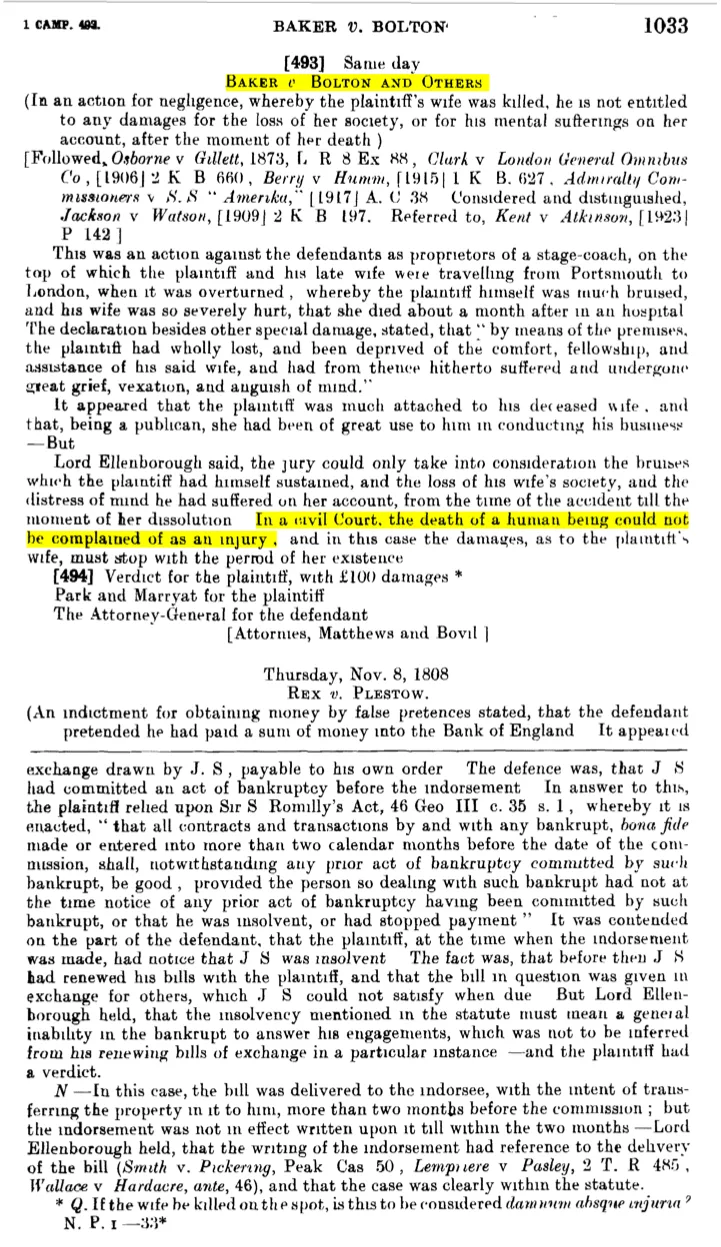
That is the entire substantive holding. The report cites no authority for the proposition that "the death of a human being could not be complained of as an injury." It gives no analysis. It does not explain why a husband may recover for the loss of his wife's society until the moment of her death but not for the years of society lost thereafter. The line that became "the common-law rule" was, in its original setting, an asserted limit without a stated reason — and a limit that does not even cohere with the recoveries the same charge permitted on the same set of facts.
Lord Campbell's Act: how the same lawyer turned Baker into received doctrine
Baker v. Bolton would likely have remained an obscure trial-court ruling but for what came next. In 1846, Parliament enacted the Fatal Accidents Act — known to legal history as Lord Campbell's Act — which created a statutory wrongful-death action for the surviving family of a person killed by another's wrongful act. The Act's preamble opens with this recital: "Whereas no action at law is now maintainable against a person who by his wrongful act, neglect, or default may have caused the death of another person…."
The recital is the engine of the modern myth. It states the proposition as established law and then enacts a statutory remedy on the assumption that no common-law remedy existed. Courts citing the Act for the common-law proposition began to multiply, and the Act in turn cited Baker as its supporting authority. The citation chain effectively closes.
Lord Campbell's Act was drafted by John Campbell — by the time of the Act's passage Lord Campbell, but at the time of the Baker report a young barrister cobbling together one of his early law-reporting projects. The same lawyer who reported the bench remark drafted the parliamentary preamble that elevated the bench remark into received doctrine. That coincidence is the historical foundation on which the modern position rests.
Felony merger: the rule that actually governed common-law cases involving death
To see why Baker is wrong on its own terms, it helps to understand the doctrine that actually governed pre-1808 English cases involving death. The rule was felony merger — sometimes called Crown merger. The doctrine held that when a tort amounted to a felony, the private cause of action was suspended in deference to the Crown's prosecutorial interest. The doctrine was procedural in form and substantive in effect: pending prosecution, the victim's civil claim could not proceed; and because most felonies in early-modern England were capital and entailed forfeiture of the felon's property, the suspension was usually permanent in practice. By the end of the eighteenth century, felony was a sweeping category — Leon Radzinowicz counts roughly two hundred capital offenses, including arson of a haystack at night.
The standard authority for the proposition that no civil action lay for a death isHiggins v. Butcher, 80 Eng. Rep. 61 (1607). The reported holding is that a master could not maintain an action against the man who beat his servant "so that he dies of that battery," because the battery was capital homicide and therefore "an offence to the Crown … and that drowns the particular offence, and private wrong offer'd to the master before, and his action is thereby lost." The case is regularly cited for the proposition that no civil action lay for the death of a human being. It does not say that. It says, in terms, that the felony absorbed the private wrong; the rule operates only when the underlying conduct is a felony.
That distinction matters. Many tortious deaths were not felonies. Negligent conduct that caused death was not a felony at common law; involuntary manslaughter in the performance of a lawful act was a misdemeanor. Where the underlying conduct fell short of felony, the felony-merger rule did not apply, and the private claim proceeded. Wrongful-death actions in negligence cases were available before Baker, were available after Baker, and were available without any need for statutory authorization.
The English record: Markham, Dawes, Jones v. Perry
The English cases bear that out. W. S. Holdsworth, whose seventeen-volume History of English Law remains the standard treatment, identified two seventeenth-century cases —Markham v. Cobb (1625) and Dawes v. Coveneigh (1652) — in which civil actions proceeded against felons after the felony-merger suspension lifted. The mechanism was benefit of clergy: a felon convicted but spared the gallows under the lenient statutes of 1566 and 1576 forfeited property held at the time of the offense, but could be sued on later-acquired property. The cases are not edge cases; they are the rule operating as it was supposed to operate.
For negligence cases — where felony merger never applied at all — the most direct authority is Jones v. Perry, 2 Esp. 482 (1796). The defendant kept a dog that bit the plaintiff's child; the child died of the wound. The action was broughtper quod servitium amisit — on the theory of lost service to the parent — and the jury awarded thirty pounds. There was no felony, so there was no merger, and the recovery was unremarkable. The decision predates Baker by twelve years and undermines its premise on its own facts.
Holdsworth's 1916 study concluded that "when Lord Ellenborough gave his ruling inBaker v. Bolton he was the victim of the same confusion of ideas." T. A. Smedley, writing in the Vanderbilt Law Review in 1960, agreed: Ellenborough "unwittingly (or, if deliberately, wholly without authority) phrased his rule too broadly and thereby caused the restriction against recovery to be extended to a degree not warranted by the earlier decisions." Malcolm Mason, a fellow of the Foundation for Research in Legal History, put the point more directly: "The rule that no action may be brought against one who wrongfully causes another's death has no foundation in common law principle." None of these assessments has been seriously contested by the historians who have looked at the question.
The American record: Cross v. Guthery, the colonial cases, Shields v. Yonge
The American historical record is at least as adverse to Baker. Three pieces of it bear on Georgia and on any state that anchors a constitutional right to a founding-era baseline.
First — and most important to the argument from common-law principle — Cross v. Guthery, 2 Root 90 (Conn. 1794). The action was brought by a husband whose wife had died after a negligent surgical operation. The defendant invoked felony merger; the Connecticut court rejected the defense on the ground that "the rule urged by the defendant, is applicable, in England, only to capital crimes, where from necessity, the offender must go unpunished, or the injured individual go unredressed." The jury returned a verdict of one thousand pounds — measured against contemporaneous wages of roughly fourteen pounds a year, a recovery in the low millions of present-day dollars. The case is not buried in some county-court archive: it was reported by Jesse Root, a justice of the Connecticut Superior Court and former Chief Justice, in his published Reports. Cross predatesBaker by fourteen years and reaches the opposite result by reasoning from the same common-law sources.
Second, the colonial records of Massachusetts Bay and Connecticut contain a string of seventeenth-century cases in which juries assessed damages payable to the family of a person killed by another's wrongful act. The 1643 case of John Ewe, who negligently killed Thomas Scott; the 1675 cases of John Foster (accidental shooting of Samuel Flack) and James Foord (cart driven over Abigail King); the 1677 manslaughter cases of John Flynt and Samuel Hunting, in which juries ordered the defendants to pay the decedent's family alongside the criminal sentence. The mechanism in those cases differs from a modern tort recovery — payments were ordered in the same proceeding as the criminal sentence — but the substantive proposition that a civil money remedy lay for a wrongful death was unmistakably accepted.
Third, and controllingly for Georgia: Shields v. Yonge, 15 Ga. 349 (1854). A father sued the operator of a railroad whose negligence killed the father's son. The defendant pressed felony merger. The Georgia Supreme Court — fully aware of the doctrine and ofBaker v. Bolton — held that involuntary manslaughter in the performance of a lawful act was a misdemeanor, not a felony, and therefore that "the private injury which resulted from the homicide, was not merged in the public injury, or suspended until after that had been avenged." The Court further addressed Baker directly, observing that "[n]o authority is cited for this opinion" and concluding: "I must say, therefore, that Lord Ellenborough's unsupported Nisi Prius declaration … opposed, as it is, to the expressed opinion of Comyn — to the, plainly to be implied, opinion of Blackstone — from every inference from analogy to the maxim, that where the reason is the same, the law is the same, seems to me to be too broad." Shields has never been overruled. It remains controlling Georgia precedent for the proposition that a wrongful-death claim existed in Georgia under common law where the death was caused by negligence.
Bibbs v. Toyota and the propagation problem in modern citations
There is a wrinkle in Georgia's case law that any brief in this area has to address head-on. In Bibbs v. Toyota Motor Corp., 304 Ga. 68 (2018), the Georgia Supreme Court citedShields v. Yonge for the proposition that "at common law, the death of a human being could not be complained of as an injury." That is the Baker v. Boltonsentence, attributed to Shields.
The attribution does not survive a careful reading of Shields. Shieldsquotes Baker's language and then expressly rejects it as "too broad" and as opposed to the "expressed opinion of Comyn" and "the, plainly to be implied, opinion of Blackstone." What Shields actually holds is the opposite of what the Bibbs citation implies. The Court in Bibbs was not asked to reconsider Shields, and the relevant passage in Bibbs is dictum on background doctrine — not the basis of the decision. But the loose reading ofShields in Bibbs is the kind of judicial repetition by which theBaker v. Bolton myth has propagated for two centuries. A response brief that engages the historical record has to engage Bibbs and Shields together — pulling the citation back to the original holding, and showing that the older case does not support the proposition the later case treats it as supporting.
Actio personalis moritur cum persona: the maxim that is sometimes raised, and why it fails
A defendant pressed against the historical record will sometimes invoke the maximactio personalis moritur cum persona — "a personal right of action dies with the person." The maxim is a poor fallback for two reasons.
First, it does not address wrongful-death claims. The maxim governs the survival of the decedent's own causes of action — the rights now brought by the estate, not by a wrongful-death plaintiff. A wrongful-death claim is a survivor's claim for the survivor's loss; the maxim has no purchase on it. The legal historian Henry Goudy described the doctrine as one whose origin and "true import" were both obscured by "the veil of obscurity." Frederick Pollock called it "one of the least rational parts of our law." The doctrinal weight defendants seek to attach to the maxim is more than the maxim itself ever bore.
Second, in Georgia the maxim was abrogated by statute long before the constitutional baseline. The non-abatement act of 1789 — codified at Watkins's Digest 395, § XVIII (1800) — extinguished the rule for actions whose cause survived the death of a party. Whatever residual support the maxim might have lent to Baker's proposition, that support was unavailable in Georgia by the time of the 1798 Constitution. States with nineteenth-century non-abatement or survival statutes will face the same analysis.
Why this matters: state-constitutional preservation of common-law rights
The historical correction is not academic. In several states, the constitutional jury-trial right and the constitutional wrongful-death right are tied to the common-law remedies that existed when the constitution was ratified. Georgia is the most developed example. UnderNestlehutt and Taylor, the question whether a statutory damages cap impermissibly intrudes on the jury-trial right turns on whether the cause of action existed at common law in 1798. The answer determines whether the cap is constitutional in any given category of cases.
If wrongful-death claims existed at common law in 1798 — and they did, both in Georgia and in the broader common law that informed Georgia law at ratification — then a statutory cap on noneconomic damages in wrongful-death cases sits in the same constitutional position as the cap struck down in Nestlehutt. The Court need not extend Nestlehutt to reach that result. It need only stop crediting the Baker v. Bolton myth.
The point is portable. States with similar preservation doctrines — open-courts clauses, jury-trial clauses, wrongful-death clauses anchored to ratification — will face the same question. The historical record is the same. The defense's reliance on Baker v. Bolton and on the supposed common-law bar is the same. The brief-writer's job is to put the historical record into the response: not to argue against the supposed bar as a given, but to displace it. That requires reading Baker v. Bolton as what it is — a half-page report of a bench remark, propagated by a self-referential legislative preamble, contradicted by the actual cases on both sides of the Atlantic, and rejected by serious historians for over a century.
For the brief-writer
A response brief that engages the historical record on common-law wrongful-death recovery should:
- Lead with felony merger, not with Baker v. Bolton. The doctrine that actually governed pre-1808 English cases is the felony-merger rule. QuoteHiggins v. Butcher in full; show that the holding is conditional on the underlying conduct's status as a felony. The defense's reliance on the bare line that "the death of a human being could not be complained of as an injury" depends on readers not understanding the doctrine the line is meant to rest on.
- Cite the pre-1808 cases. Cross v. Guthery (Conn. 1794) does the most work; it predates Baker, expressly limits felony merger to capital crimes, and produced a substantial wrongful-death recovery on the same negligence theory at issue today. Jones v. Perry (1796) does similar work on the English side. The colonial Massachusetts Bay and Connecticut records are corroborative; cite them, but do not lean on them, because their procedural posture differs from a modern tort suit.
- Anchor on still-binding state precedent. In Georgia that isShields v. Yonge — a pre-statutory decision in which the Georgia Supreme Court recognized common-law wrongful-death recovery in negligence cases and expressly rejectedBaker. Other states with parallel preservation doctrines should look for their own pre-statutory wrongful-death authority; in many states it exists and has gone uncited because the Baker premise crowded it out.
- Address Bibbs v. Toyota — or its analogue — head-on. A modern Georgia brief cannot pretend Bibbs's stray sentence does not exist. The right move is to pull the citation back to Shields and show that Shieldsrejects what Bibbs cites it for. Where another state's case law contains a similar misattribution, the same move applies.
- Park the actio personalis fallback. Show that the maxim does not apply to wrongful-death claims, and where the relevant state has a non-abatement or survival statute predating the constitutional baseline, show that the statute abrogated the maxim before the baseline.
- Tie the historical correction to the relevant preservation framework.The historical record is necessary but not sufficient. The brief has to connect "wrongful-death claims existed at common law" to "the damages cap is therefore unconstitutional under Nestlehutt" — or the local analogue. Without the second step, the historical work is detached from the constitutional doctrine the court has to apply.
The Baker v. Bolton myth has had a remarkable run. It has survived two centuries of contrary cases, of Holdsworth's 1916 demolition, of Mason's archival work, of the contemporaneous American courts that refused to follow Baker on its own merits. It has survived in part because the historical question rarely matters; common-law doctrine before 1800 sits at the edges of a working litigator's daily concerns. But where it does matter — under state constitutions that preserve common-law rights as they existed at ratification — it matters a great deal. Reading the actual record displaces a long-running myth, and that displacement opens the constitutional argument the cap is meant to foreclose.